
In defence of DJ labour: A response to Phil Mongredien
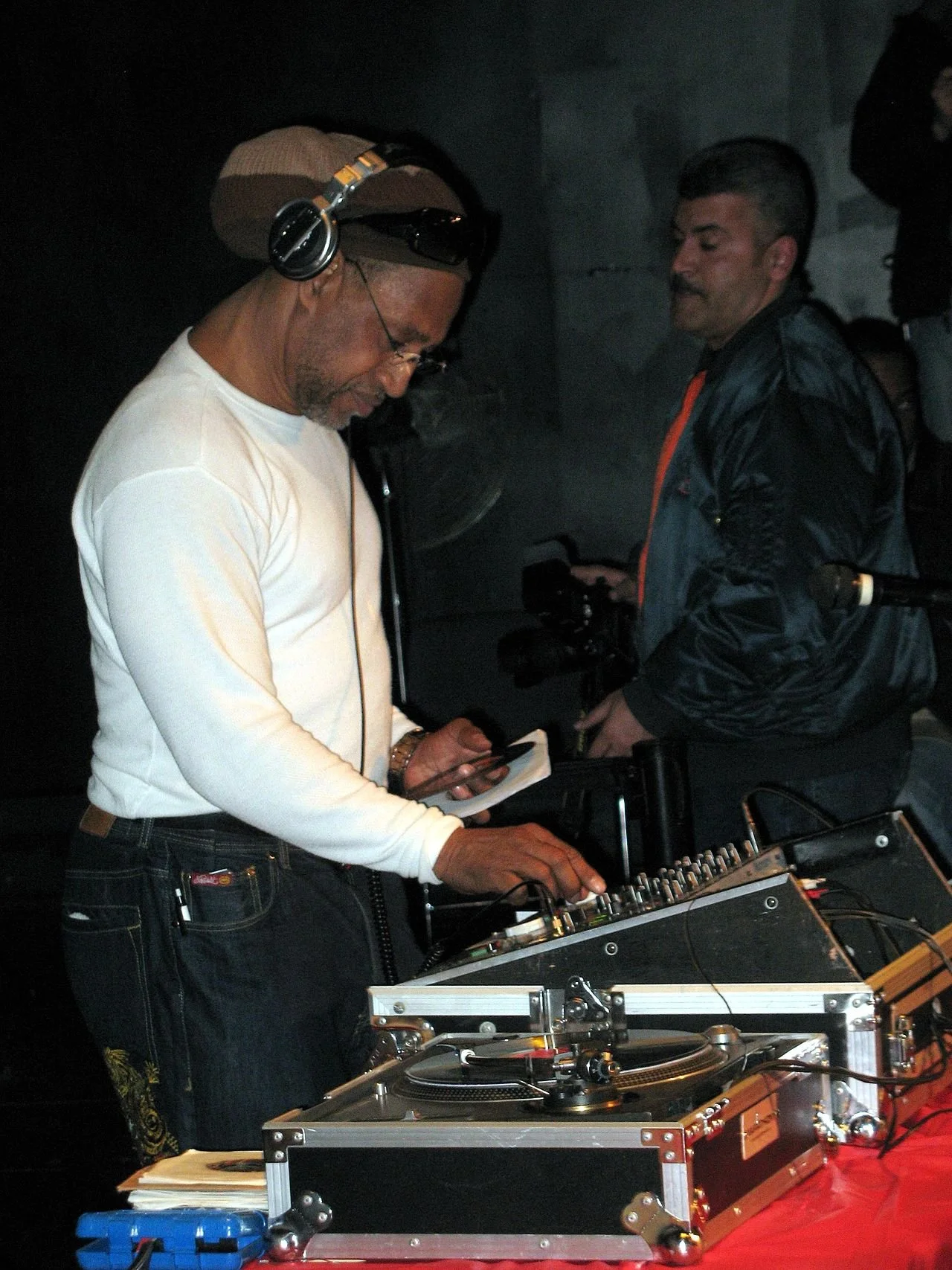
On 16 February (which is today for me), Phil Mongredien penned an unfortunate opinion piece for the Guardian, lamenting the undue phrase and adulation we as a culture apparently laud upon DJs. Highlighting a couple prominent and highly paid outliers of DJ practice, Mongredien makes the bold claim that DJs barely do any work—and the work they do is not particularly heady—yet they are celebrated to the detriment of the brilliant artists whose records they are spinning.
Our worship for these people is ‘totemic,’ Mongredien writes, and this ‘cult of the DJ’ overshadows every other form of labour that makes club nights possible: the creativity of the artist, the skill of engineers and technicians, and, in an almost Smallean manner, even the quiet labour of hospitality staff like bartenders and cleaners or the ‘cab driver who takes you home.’
While I am sympathetic to some of Mongredien’s points, and he does an OK job trying to hedge what presumably needed to be a somewhat inflammatory headline, the piece on the whole is a trainwreck of griping and summary dismissal. While the piece itself is trivial, it feels important want to quickly respond to what semblance of an argument exists in Mongredien’s brief missive.
How to pretend paid labour isn’t a job
The central premise of Mongredien’s piece is that the labour involved in DJing (which he characterises as ‘a couple of hours’ work’ at most) does not constitute a job (or, as he describes it, ‘isn’t a proper job’). Excusing the fact that ‘author of opinion pieces’ seems to be a field of work the world could quite easily do without, his characterisation of what kinds of labour constitute ‘real work’ is rooted in some deeply historical (and, one might say, uncomfortable) ideas about labour. When someone argues that a class of labour is neither real nor proper and thus does not merit pay, it is a claim that merits a high level of scrutiny.
On the surface level, this argument obviously relies on the fallacious reasoning that somehow the performance of a service in exchange for financial consideration can be excluded from the category of ‘real/proper job.’ It is an appeal to purity so naked that it could only be tolerated by those with no desire to interrogate the claim. Thus, it falls almost immediately upon Mongredien to try and square the circle.
Unfortunately for him, the rhetorical ground of his piece is highly unstable. Whereas the headline professes that DJing is not a ‘proper job,’ the actual text of the opinion has to walk this back, declaring that DJs ‘are proficient labourers rather than artists,’ creating the confusing situation where one has to explain how being a ‘proficient labourer’ isn’t a ‘real’ or ‘proper’ job.
Credit where credit’s due
That explanation comes, in part, from the idea that a DJ does not ‘earn’ the money they receive; they simply ‘get paid,’ sort of unrelatedly, I suppose. This semantic flourish means very little, though, as it is again left unclear how or why getting paid for a service one provides is not the same thing as earning something. Casual reasoning suggests that the difference lies in the assumption that to ‘earn’ requires something to be duly given. Simply put, DJs don’t deserve any money for their work because it is the pointless trifling of idiots. The money argument must be total, because if any of the money is duly earned, then it is even harder to put forth that DJing isn’t a real job. So, who has rightfully earned the money that is currently being siphoned by undeserving DJs? For Mongredien, the ‘who’ is the artist.
Mongredien headlines the accusation that DJs are ‘taking the credit’ for the work of artists, but Mongredien (quite puzzlingly) doesn’t spend time laying out how exactly this credit is being stolen. He doesn’t explicitly claim these DJs are portraying themselves as the true authors of these tracks; he doesn’t spend long convincing the reader that DJs are so egotistical that they claim everything is theirs; he doesn’t cite any controversies of mistaken identity or any artist/producer/composer accusations.
What he does do is trace this supposed usurpation of credit to a time in the late twentieth century when electronic dance music (EDM) had no particular cachet and was roundly ridiculed as unknown, unknowable garbage. This ‘snobbery,’ Mongredien surmises, is the origin of the ‘cult of the DJ’ that has led to egomaniacal dullards outshining the artists they are spinning.
The ‘cult’ is the product of a simple transference: in absence of the artists who actually created a track, the DJ is (ostensibly) substituted in by the listener as the source and thus receives the veneration. Musicological enquiry would normally demand some corroborating evidence—perhaps by speaking to clubgoers or DJs or whatever; in the realm of opinion journalism, though, the sheer possibility of this belief (however fringe or unlikely) is enough to become outraged.
Mongredien carelessly excises the DJ from the practice of EDM, presenting them as by far the least important part of the musicking experience, less so than a worker who was not even present at the venue for the event. Historically, though, the DJ is a celebrated archetype of Black musical creation and an integral part of the practice of many musical genres, so Mongredien’s laser focus on this archetype is reminiscent of uncomfortable histories of Black musicians and Black music practice. It echoes longstanding patterns of devaluation that have historically attached to Black musical labour, whether or not he intends or recognises it.
Black in the sun, Black in the shade
This is the point where the argument really falls apart. Disc jockeying, an art form that was pioneered in great part by Afrodiasporic individuals and communities is summarily dismissed by Mongredien, a (White) British opinion writer, without a single reference to the Black titans and vanguards of DJ practice (and its adjacent practices, as none of these are hermetically sealed) or its unique presentation as a form of Black musical labour.
There are two concepts worth exploring quickly: Black music and hidden labour. In musicology literature, Black music is a complex idea that refers to sonic traditions that have emerged out of or are highly associated with African and Afrodiasporic cultures and societies. Black music not a mutually exclusive label; much like how ‘British’ rock does not overwrite rock’s American/Afrodiasporic cultural origins, anyone anywhere is able to create and engage with Black music. In countries like the US and the UK, Black music is widely participated in by a diverse range of practitioners, so figures like David Guetta or Calvin Harris can still be understood as a participant in a Black musical tradition. (The extent, appropriateness, and respectfulness of their participations are, in my opinion, open questions.)
Accordingly, by hidden labour, I do not strictly mean the labour that is presently or historically performed by Black people (although this labour is included in many instances) but rather the forms of labour that exist in the shadows, so to speak, and are easier to render invisible. (Ironically, these invisibilised forms of labour may be fully on display, as is the case with a DJ.) Domestic labour is perhaps the most towering example of invisibilised labour, and the historical link between domestic labour and Blackness should not need articulating here.
Of course, DJing is neither domestic nor ontologically unpaid, but it can still clearly be pushed into the shade where any contribution they make to the clubgoing experience is essentially nil and entirely noncognitive. Other Black cultural artforms or creative archetypes have been subjected to similar kinds of scrutiny and dismissal, from ragtime pianists to jazz composers to rappers, so it is not surprising to see a comparable argument be levelled at another Black creative archetype.
Mongredien makes clear that his target of ire in his opinion piece is not meant to harken to the ‘racist and homophobic “disco sucks” campaign,’ yet regardless of intent, he spares no time highlighting or even thinking about the pioneering DJs, many of whom were Black, who, alongside artists and producers, brought a club culture like disco into thriving existence. There is no point at which Mongredien separates this critical history of club music culture from the rise of ‘cult of the DJ’ that merits this level of critique.
As far as we can understand from his argument, the DJ has always been a superfluous attention hog whose image and history is fully captured by the likes of Guetta and Harris. Dismissing DJ practice as cognitively trivial without acknowledging its cultural and historical formation risks reactivating a familiar hierarchy in which Black-associated musical labour is framed as derivative rather than creative, and this is the case even when the subjects of his ire are predominantly White.
The big reveal
Perhaps the least answerable question of Mongredien’s piece is why he would author it at all. What exactly is he trying to express with this piece, and what particular end is hoping to achieve? It is an opinion he intends to carry to the grave, after all. Holding an odd opinion is one thing, but publishing said opinion in a national newspaper reflects a somewhat different animus.
Let’s presume this is not an oblique attempt to ‘cancel’ Guetta or Harris or even Paris Hilton (for whom he really has it in). Perhaps Mongredien is simply angry (jealous?) about the money. The lead-in to the piece is that DJs like Guetta and Harris are raking in nearly £1 million to spin a few digital records, a task that amounts to essentially no effort or cognition.
While I’m not going to sit here and defend capitalism’s gross (and inherent) inequities, nor the garishness of musical elitism, if Mongredien is so stirred by the idea of vast sums of money going where it arguably shouldn’t, there are, I should think, far more prudent areas of focus for a journalist with the platform of a national newspaper.
Maybe Mongredien is just tired of idiots and has identified DJs as his befuddling target. He is clearly not afraid to declare the DJ’s sheer stupidity, unable to write and far less brilliant than they think they are.
While I cannot know for sure, I find it amusingly ironic that Mongredien earned (sorry, ‘got paid’) what was likely a fairly comfortable cheque from the Guardian for, funnily enough, what probably amounted to even less than a couple hours’ work. It cannot take much effort to gripe about something so terribly inconsequential, so it is an embarrassing position from which to level such admonishment.
Who cares if you curate?
At the end of the day, Mongredien inadvertently reveals himself to be someone who doesn’t care much what he hears in a club context (maybe he is accusing his reflection when he speaks of those clubgoers who are ‘on another planet’). All the music is more or less the same to him in this context, so a DJ’s ability to choose one track over another or to curate a specific aesthetic experience for their listeners means essentially nothing to him.
As I mentioned before, it’s not clear what the endgame is for Mongredien. What is he hoping would change about DJs as they currently exist? He writes that it’s ‘time to put the “dancy” back into “redundancy,”’ so I guess it is finally time to hand the role over to an AI-generated, random shuffle, Spotify playlist (with a three-second crossfade, of course).